
Fitness Testing is the fastest way to turn “I think I’m improving” into “I know what changed, and why.” If you train consistently but your pace, strength, or energy feels stuck, a few simple checks can reveal whether the issue is conditioning, strength balance, recovery, or even pacing strategy.
The value is not the test itself, it’s the decision you make after. The right performance check can keep you from chasing random workouts, help you set realistic goals, and reduce overuse risk by catching imbalances early.

This guide focuses on practical fitness assessments you can run with minimal gear, how often to repeat them, and how to interpret results without overreacting to normal day-to-day fluctuations. If you’re training for a sport, a 5K, or just better health markers, the same logic applies: test, adjust, retest.
What “performance check” actually means (and what it doesn’t)
A performance check is a structured snapshot of your current capacity: aerobic fitness, strength, power, mobility, and sometimes body composition. It’s not a full medical evaluation, and it doesn’t diagnose anything.
According to the American College of Sports Medicine (ACSM), fitness components commonly include cardiorespiratory fitness, muscular strength and endurance, flexibility, and body composition. In real life, you do not need a lab to get useful signals, but you do need consistency in how you test.
Here’s the mindset shift that helps: one test rarely tells the whole story. Most people do better with a small “battery” of tests that cover multiple systems.
Why your training can feel stalled: common causes Fitness Testing can uncover
When progress slows, many people assume they need “more intensity.” Sometimes true, often not. Fitness Testing tends to reveal a few repeat offenders.
- You improved one system but not the limiter, like stronger legs but unchanged aerobic base, so your running pace still feels hard.
- Strength imbalance, for example left-right differences that force compensations, making lifts feel stuck or form break down.
- Poor repeatability, meaning you can hit one good effort but can’t sustain it across intervals, sets, or quarters.
- Recovery mismatch, where sleep, fueling, or weekly load leaves you under-recovered, so tests look worse even if training is solid.
- Testing noise, like doing a hard test after leg day, changing shoes, or switching protocols, then reading the result as “regression.”
In practice, the “fix” is usually more boring than people want: adjust weekly volume, tighten intensity distribution, or build strength where you’re leaking force.
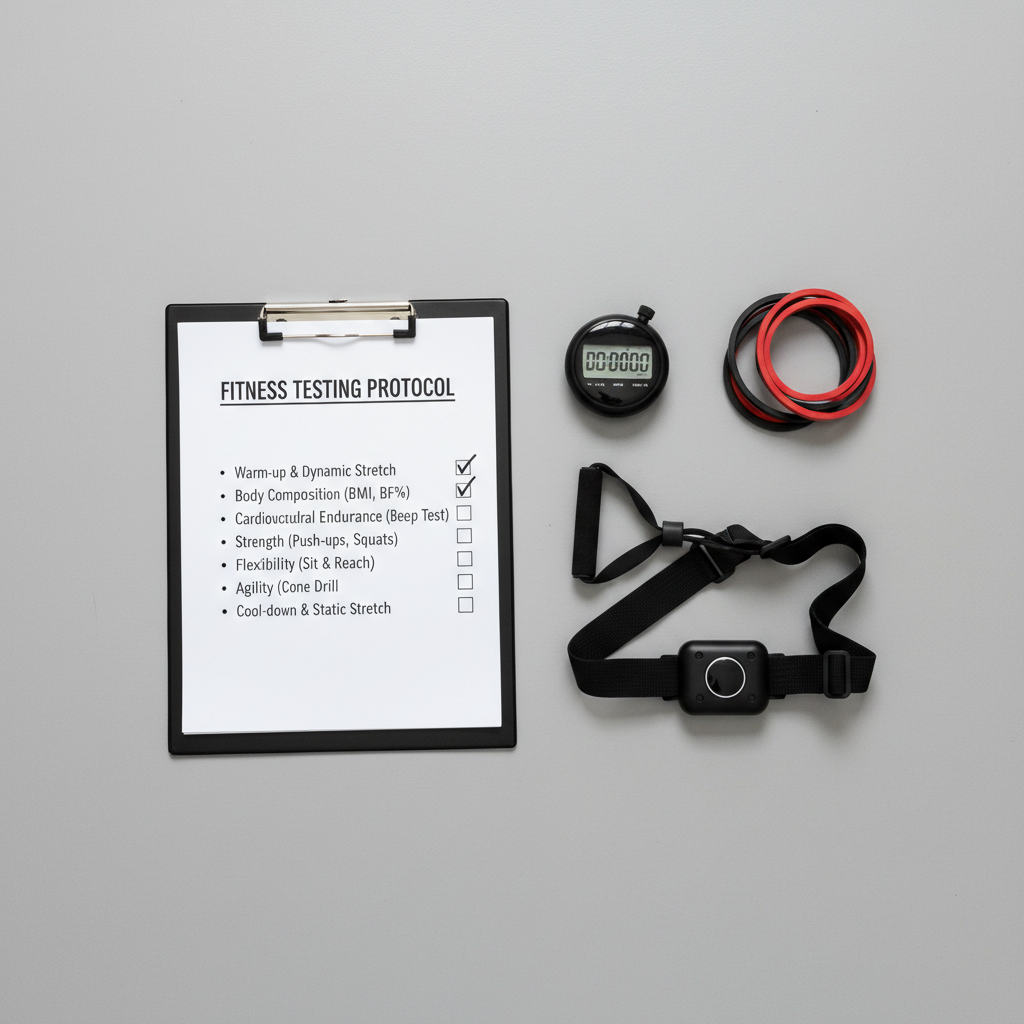
A simple Fitness Testing battery (pick 4–6, not 20)
Fitness Testing works best when it’s repeatable and relevant. Choose tests that match your goals and that you can run the same way each time.
Cardio / endurance options
- Cooper 12-minute run (distance covered): simple aerobic indicator on a track or flat route.
- 1-mile time trial: practical for runners and field sport athletes.
- 3-minute step test (heart rate response): useful if you prefer low-impact checks.
Strength / muscular endurance options
- 3–5RM estimate for squat, deadlift, or bench (only if technique is reliable).
- Max push-ups in 2 minutes: upper-body endurance with minimal setup.
- Max strict pull-ups (or assisted reps): useful strength-to-bodyweight marker.
Power and speed options
- Vertical jump (best of 3): lower-body power proxy.
- 10–20 yard sprint (best of 2–3): acceleration check for many sports.
Mobility / movement quality options
- Overhead squat screen (video): flags ankle/hip/thoracic restrictions.
- Active straight-leg raise: hamstring and hip control snapshot.
If you’re unsure what to pick, start with: one endurance test, one strength test, one power/speed test, and one mobility screen. That mix tends to stay informative for most recreational athletes.
Self-check: are your results trustworthy or just a bad test day?
Before you “fix” your program, confirm the data is clean. A lot of frustration comes from comparing apples to oranges.
- Same conditions: similar time of day, surface, temperature, shoes, and equipment setup.
- Same warm-up: keep it scripted, even if it feels repetitive.
- Recovery status: avoid testing right after a brutal session, long travel, or short sleep.
- Health check: if you feel sick or unusually fatigued, postpone.
- Technique stable: if you’re still learning the lift or movement, early “gains” may be skill, not fitness.
A good rule in many cases: if the result is only slightly worse than last time, assume normal variance and look for a trend across 2–3 testing cycles.
How to run the tests: a repeatable protocol you can stick to
Consistency beats complexity. If you want Fitness Testing to drive training decisions, treat it like a mini event.
Suggested testing order (to reduce interference)
- Movement screen (mobility, stability)
- Power/speed (jumps, sprints)
- Strength (heavy lifts or rep tests)
- Endurance (run/row time trial or step test)
Timing and frequency
- Every 6–10 weeks works for most people who train 3–6 days per week.
- If you’re newer, you may see meaningful changes sooner, but avoid testing so often that it replaces training.
- For in-season athletes, keep it lighter: pick 2–3 low-fatigue checks rather than full max efforts.
According to the Centers for Disease Control and Prevention (CDC), adults benefit from both aerobic activity and muscle-strengthening activity weekly. Your testing plan should reflect that mix, otherwise you only measure what you already prefer doing.
Reading the results: what to change (and what not to overthink)
The point of a performance check is to guide the next training block. Keep interpretation practical.
- Endurance improved, strength flat: keep cardio progression, add a focused strength block, and protect recovery.
- Strength up, endurance down: re-balance weekly aerobic volume, watch intensity creep, and check bodyweight changes.
- Power down, strength steady: you may need more speed work, more rest between heavy sets, or less accumulated fatigue.
- Mobility limits show up repeatedly: prioritize targeted mobility plus technique coaching, not random stretching.
Key point: one weak score is not a verdict. A pattern across multiple tests, repeated over time, is where you should act.
Practical table: common goals and matching tests
If you want a simple way to choose, this mapping usually holds up.
| Goal | Good primary tests | Useful secondary checks | How often to retest |
|---|---|---|---|
| Run faster 5K | 1-mile time trial, 12-min run | Single-leg strength (split squat), mobility screen | 6–8 weeks |
| Build general strength | 3–5RM estimate (squat/bench/deadlift) | Push-ups, pull-ups, jump test | 8–10 weeks |
| Field/court sport performance | 10–20 yd sprint, vertical jump | Shuttle-style conditioning test, asymmetry checks | 6–10 weeks |
| Improve health and energy | Step test, brisk walk time/distance | Basic strength endurance (push-ups), mobility screen | 8–12 weeks |

Common mistakes that waste a test day
Most testing errors are boring. They’re also common, especially with motivated people who want quick feedback.
- Changing too many variables: new route, new device, new warm-up, then treating the number as comparable.
- Testing when exhausted: you learn “I’m tired,” not “I’m unfit.”
- Maxing out too often: frequent 1RM attempts can raise injury risk, especially without coaching.
- Ignoring technique: a stronger score with worse form may not be progress you can use safely.
- No follow-up plan: collecting numbers without changing training is just trivia.
If you have pain, dizziness, chest discomfort, or a health condition that affects exercise tolerance, it’s smarter to talk with a clinician or qualified professional before pushing hard tests. Many situations are manageable, but guessing is not a strategy.
Action plan: your next 7 days
If you want to start without overhauling your routine, keep it simple and structured.
- Day 1–2: pick 4 tests that match your goal, write the exact protocol, and schedule a test day.
- Day 3–5: train normally but avoid piling fatigue right before testing.
- Day 6: run the battery, record notes on sleep, soreness, and conditions.
- Day 7: choose one training adjustment based on the biggest limiter, and keep everything else steady for the next block.
Key takeaways: Fitness Testing works when it’s repeatable, limited to what matters, and tied to a real training change. Pick a small battery, retest on a schedule, and look for trends instead of obsessing over a single number.
If you’re ready, put a retest date on your calendar now. That tiny commitment is what turns a “check” into actual progress.
FAQ
How often should I do Fitness Testing if I’m a beginner?
Usually every 8–12 weeks is plenty. Early improvements can happen fast, but testing too often can distract from learning good technique and building consistency.
Can I do Fitness Testing at home without equipment?
Yes, in many cases. Push-ups, a timed mile (or brisk walk), a step test using stairs, and simple mobility screens can still provide useful signals if you repeat them the same way.
What should I do if my endurance improves but my strength numbers drop?
Check recovery and total weekly load first, then consider a short strength-focused block while keeping aerobic work steady. A small shift in priorities often fixes this without drastic changes.
Are 1RM tests necessary to measure strength?
Not always. Many people do better using a 3–5RM estimate or submax rep tests, especially if lifting technique is still developing or if training solo.
Why do my results vary even when my training is consistent?
Sleep, stress, hydration, heat, and test timing can all move the needle. That’s why trends across multiple test cycles matter more than a single score.
Which Fitness Testing metrics matter most for “general fitness”?
A simple mix tends to work: one aerobic check, one upper-body endurance test, one lower-body strength test or proxy, and a basic mobility screen. It covers the big rocks without getting complicated.
When should I consult a professional instead of self-testing?
If you have persistent pain, a history of heart or respiratory issues, dizziness with exertion, or you’re unsure about lifting form for heavy attempts, a qualified coach or healthcare professional can help you test more safely.
If you’re training hard but the numbers feel confusing, or you want a more streamlined way to set up Fitness Testing and interpret results, working with a qualified coach can save time and reduce trial-and-error while keeping the plan realistic for your schedule.