
Football Fitness comes down to one simple idea: train for repeated high-intensity efforts, not just “being in shape.” If you can sprint, stop, change direction, collide, recover fast, and do it again late in the game, you’re on the right track.
A lot of players grind miles, copy a random pro workout, then wonder why they still gas out on long drives or feel slow out of breaks. The issue usually isn’t effort, it’s mismatch. Football demands short bursts, uneven rest, and strength that holds up under contact.

This guide breaks conditioning into the pieces that actually matter on the field: energy systems, speed mechanics, change of direction, strength and power, plus a weekly structure that most athletes can stick with. You’ll also get a quick self-check so you stop guessing.
What “football conditioning” really means (and why the usual approach fails)
Most plays last only a few seconds, then you get a short rest, then you go again. That pattern pushes your body to rely heavily on the ATP-PC system (quick power) and anaerobic glycolysis (hard repeats), with aerobic fitness acting like the “recovery engine” between reps and series.
So when someone builds conditioning only with long slow runs, they may improve general endurance, but they often miss the repeated sprint ability that shows up in games. You can be able to run two miles and still struggle to hit your third hard sprint on a drive.
According to the National Strength and Conditioning Association (NSCA), training should be specific to the sport’s movement patterns and intensity demands, which is a fancy way of saying your conditioning needs to look like football often enough to carry over.
Quick self-assessment: which fitness issue is actually holding you back?
Before you add more work, identify the limiter. This keeps you from stacking volume on top of a problem that’s really about speed, strength, or recovery.
- You start fast, fade hard: likely poor repeat-sprint conditioning or pacing, sometimes poor hydration/sleep.
- You feel “heavy” and slow cutting: often strength-to-bodyweight gap, stiffness, or weak deceleration mechanics.
- Your legs burn on long drives: commonly anaerobic capacity and poor recovery between plays.
- You pull muscles or get nagging strains: may be sprint exposure too low, warm-up poor, or load progressed too quickly.
- You recover slowly between sessions: often total weekly load too high, not enough easy aerobic work, or nutrition off.
If more than two bullets feel true, don’t panic. It usually means your plan lacks structure, not that you’re “out of shape.”
Build your base: strength and power first, then condition what you can express
Athletes sometimes try to “condition into” being explosive. In reality, power tends to show up when you have enough strength, you practice fast movement, and you’re fresh enough to sprint with intent.
For many high school and college players, a sensible priority looks like this:
- Strength: squat/hinge/push/pull patterns, trunk stability, single-leg strength.
- Power: jumps, throws, Olympic-lift variations if coached well.
- Speed: short sprints with full recovery, clean mechanics.
- Conditioning: repeat efforts that mimic drives and special teams.

Safety note: heavy lifting and plyometrics carry risk if technique is off. If you’re new, work with a qualified coach or trainer, and keep progress gradual.
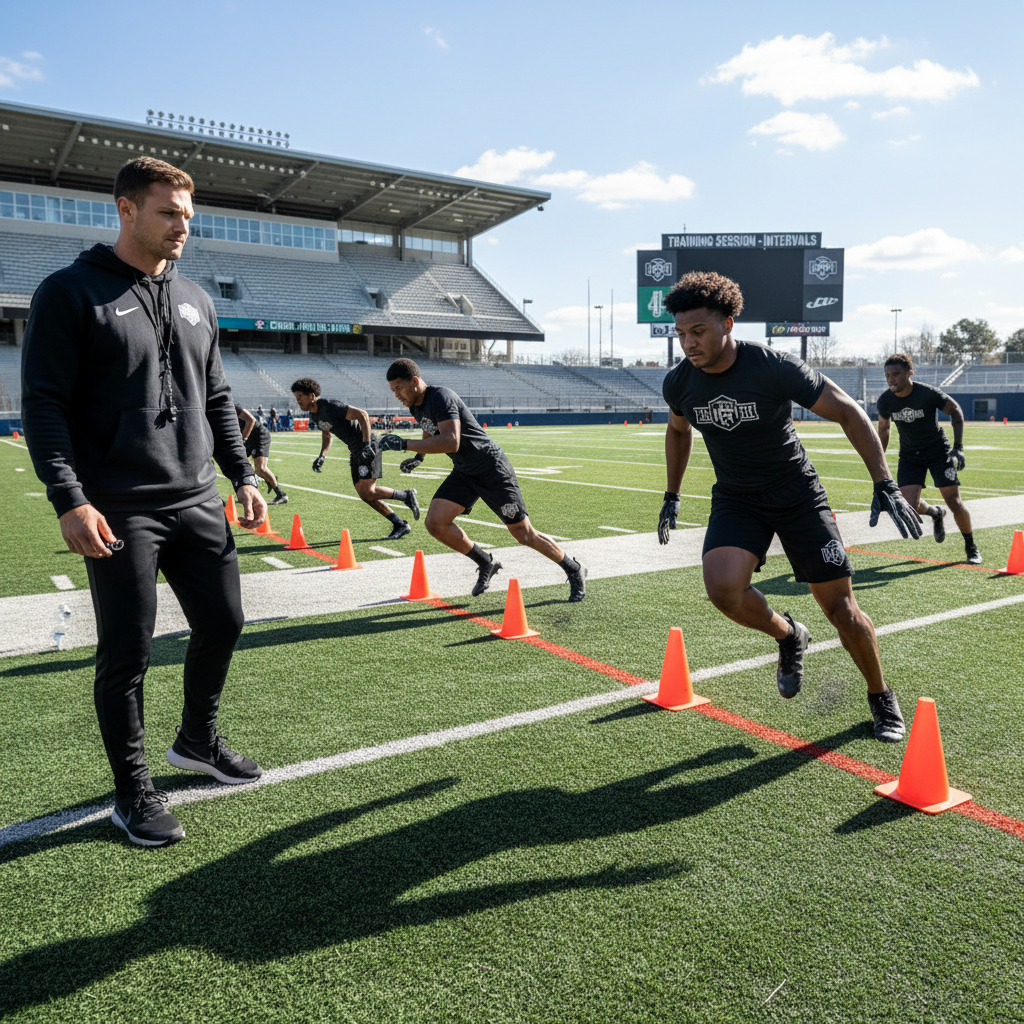
Speed and agility: train acceleration, deceleration, and change of direction separately
On film, “quickness” usually comes from two places: getting to top effort faster and braking under control. A lot of players only practice the “go” part, then wonder why cuts feel slow or knees/hips get cranky.
Acceleration (0–20 yards)
- 6–10 sprints of 10–20 yards
- Rest long enough to stay fast (about 60–120 seconds)
- Focus cue: violent first step, forward shin angle, punch the ground
Deceleration (the missing skill)
- 4–8 reps of “sprint 10, stick and stop”
- Land with hips back, knee tracking over mid-foot, chest controlled
- Progress to “sprint 10, stop, re-accelerate 5”
Change of direction (COD)
- Use simple patterns: 5-10-5, L-drill, box drill
- Keep reps crisp, stop before form turns sloppy
- Rotate angles: 45°, 90°, 180° cuts
Good COD training looks more like skill practice than conditioning. If you’re gasping every rep, you’re probably training fatigue tolerance more than sharp movement.
Conditioning that carries over: repeated sprints, tempo work, and “drive” intervals
The sweet spot for Football Fitness is mixing high-quality sprint work with intervals that build repeatability. One style rarely covers everything.
| Method | What it targets | Example | Best time to use |
|---|---|---|---|
| Repeated sprints | Repeat sprint ability, late-drive speed | 2 sets: 6 x 30 yd, 20–30 sec rest, 3–4 min between sets | Off-season, pre-season |
| Tempo runs | Aerobic base for recovery | 10–16 x 100 yd at easy-moderate pace, 30–45 sec rest | Year-round, recovery days |
| “Drive” intervals | Game-like bursts with uneven rest | 8–12 plays: 5 sec hard / 25–35 sec easy, rest 3–5 min, repeat | Pre-season, in-season maintenance |
| Position-specific conditioning | Movement patterns for your role | WR: routes + jog back; OL: short bursts + resets | Pre-season, skill days |
According to the American College of Sports Medicine (ACSM), progression and recovery are key parts of safe conditioning programs. In practice, that means you build volume or intensity step-by-step, not both at once.
A practical weekly plan (off-season vs. in-season)
You can tweak this by position, practice schedule, and equipment access, but the structure stays useful: two lower-body stress days, one speed emphasis, one conditioning emphasis, one easier recovery day.
Off-season sample week (4–5 training days)
- Day 1: Lower strength + short acceleration sprints
- Day 2: Upper strength + tempo runs (easy-moderate)
- Day 3: Power (jumps/throws) + COD skill + light assistance
- Day 4: Full-body lift + repeated sprint session
- Day 5 (optional): Mobility + low-intensity aerobic (bike, brisk incline walk)
In-season sample week (around practices and games)
- Early week: Short lift (full-body, moderate load) + brief speed exposure (4–6 x 10 yd)
- Midweek: Practice handles most conditioning, add only what’s missing
- Late week: Light neural prep (jumps, fast but low volume), prioritize freshness
Many players mess up in-season by adding “extra conditioning” when they feel tired. Usually that tired feeling is accumulated stress, not lack of effort.
Execution details that matter more than people admit
These are the boring levers, but they decide whether your plan works.
- Warm-up like you mean it: raise temperature, activate hips, then gradually sprint. Cold-to-max is where strains show up.
- Track something: sprint times, total reps, or RPE (how hard it felt). If nothing improves in 3–4 weeks, adjust.
- Rest is training: if speed drops off, stop the set. Conditioning should build capacity, not teach slow movement.
- Fuel basics: hydration, carbs around hard sessions, protein across the day. If you’re unsure, a sports dietitian can help.
- Sleep: if you’re chronically short, you’ll feel “out of shape” no matter what the program says.
If you have asthma, sickle cell trait, history of heat illness, or you’re returning from injury, conditioning plans may need extra medical oversight. When in doubt, ask a qualified clinician or athletic trainer.
Key takeaways (so you can act this week)
- Football Fitness improves fastest when you combine speed quality, strength, and repeat-effort conditioning instead of only adding miles.
- Train acceleration and braking as skills, keep reps clean, and rest enough to stay fast.
- Use a mix of repeated sprints, tempo work, and drive-style intervals, then progress gradually.
- In-season, maintain power and speed with low volume, and protect recovery so performance stays high on game day.
If you want a simple next move, pick one repeat-sprint workout and one tempo session per week, then keep your lifting consistent for four weeks, you’ll usually feel the difference on long drives before you see it in the mirror.
FAQ
How many days a week should I train for Football Fitness?
Many athletes do well with 4 days in the off-season and 2–3 structured days in-season, depending on practice load. If school practices already crush you, adding more can backfire.
Is running long distance bad for football players?
Not automatically, but it’s often overused. Easy aerobic work can help recovery, yet too much long slow running may take time and energy away from speed, power, and lifting.
What’s a good conditioning workout for linemen vs. receivers?
Linemen usually benefit from short, high-power repeats with longer rest, while receivers need more high-speed reps and route-based intervals. Both still need some aerobic base for recovery between snaps and practices.
How do I know if I’m doing too much conditioning?
Common signs include sprint times getting worse, legs feeling flat for days, sleep quality dropping, and motivation dipping. If performance trends down for 2 weeks, reduce volume and keep intensity selective.
Should I lift heavy during conditioning phases?
Often yes, but with smart dosing. Keeping 2–4 big lifts per week in the off-season is common, then tapering volume as conditioning ramps. Technique and recovery decide what’s appropriate.
What should I do if I keep getting hamstring tightness when sprinting?
Don’t ignore it. Many cases improve with better warm-ups, gradual sprint exposure, and strength work for hamstrings and hips, but recurring issues warrant evaluation by a sports medicine professional or physical therapist.
Can I improve Football Fitness without a gym?
Yes, you can build a lot with sprints, jumps, bodyweight strength circuits, hills, and structured intervals. The tradeoff is it’s harder to progress heavy strength, so you’ll need careful programming and patience.
If you’re trying to balance lifting, speed work, and conditioning without feeling constantly smoked, it may help to get a simple plan built around your position, schedule, and current readiness, so each session has a point and recovery stops being an afterthought.