
women strength training at home works, but most people quit because the plan feels random, progress feels slow, or joints start complaining before results show.
If you want a routine that actually fits a busy week, the goal is not to copy a bodybuilding split from Instagram, it is to pick a few foundational moves, repeat them, and make tiny upgrades over time.
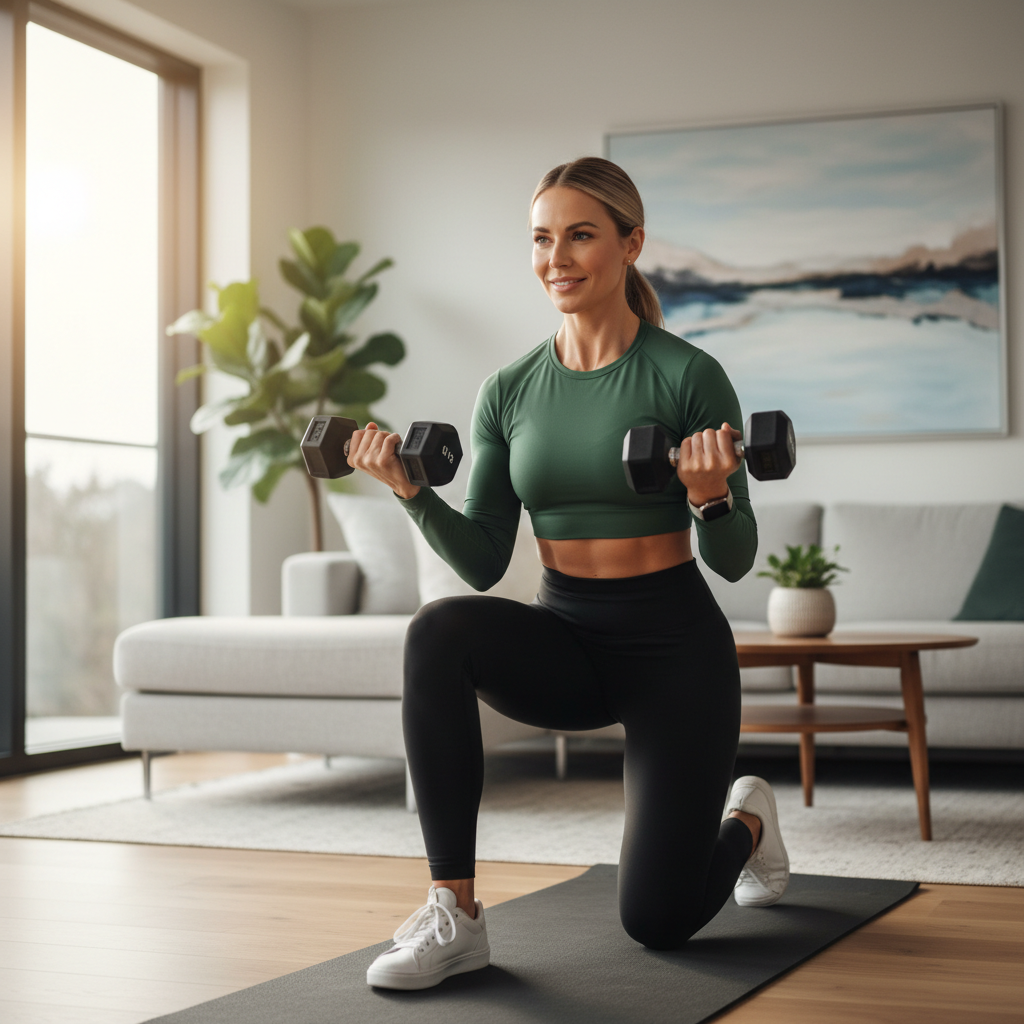
There is also a lot of noise around “toning” versus “bulking.” In real life, many women want a stronger body, better posture, and more muscle definition, without feeling like training becomes their whole identity. This guide focuses on that middle path, practical and repeatable.
Why home strength training can feel hard (and how to make it easier)
The big challenge is not motivation, it is decision fatigue. Too many exercise options, too many reps, too many programs, and your brain checks out.
- No clear progression: doing the same 10-minute video for months often means your body stops adapting.
- Form uncertainty: without a coach or mirrors, people guess, and guessing can irritate knees, hips, shoulders.
- All-or-nothing thinking: missing a day feels like failure, so the routine collapses.
- Equipment mismatch: weights too light for legs, too heavy for shoulders, so effort is uneven.
A better approach is boring on purpose: keep 6–8 core movements, track them, and progress one small variable at a time.
A quick self-check: what type of plan do you need?
Before picking workouts, get clear on your constraint, because the right plan depends on the bottleneck.
- Time-limited: you can train 20–30 minutes, 2–3 days per week.
- Energy-limited: stress and sleep make high-volume sessions unrealistic.
- Space-limited: apartment workouts, minimal jumping, quiet options.
- Strength-limited equipment: you have bands only, or one set of dumbbells.
- Joint-sensitive: past knee or back flare-ups, you need friendly variations.
If you match more than one, that is normal, just prioritize safety and consistency over “perfect.” According to ACOG (American College of Obstetricians and Gynecologists), strength training can be part of a healthy activity plan for many women, but individual medical situations vary, so checking with a clinician can be smart if you have conditions, pain, or pregnancy-related concerns.
The simplest weekly structure that still builds strength
For most beginners and many intermediates, 3 full-body sessions per week is enough to get noticeably stronger. Two days can still work if your weeks are chaotic.
Here is a clean schedule that fits real life:
| Day | Focus | Time | Notes |
|---|---|---|---|
| Mon | Full-body A | 25–45 min | Go a bit heavier on legs |
| Wed | Full-body B | 25–45 min | More upper-body pulling + core |
| Fri/Sat | Full-body A (repeat) | 25–45 min | Try to beat Monday by 1 small step |
| Other days | Walk + mobility | 10–30 min | Low friction, supports recovery |
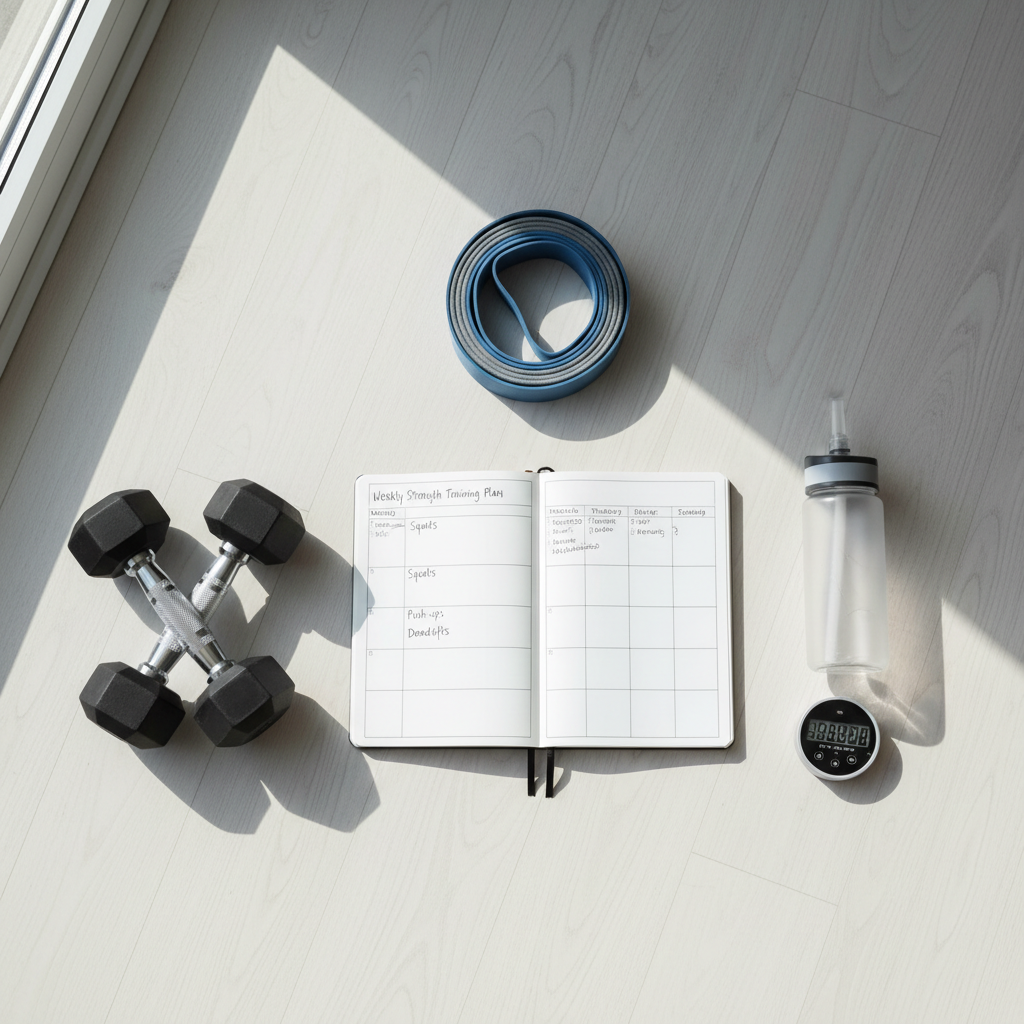
Key idea: repeat the same patterns so your nervous system learns them, then add reps, load, or control. That is how women strength training becomes measurable instead of vibes-based.
Your at-home exercise menu (pick one from each category)
If you do nothing else, cover these movement patterns: squat, hinge, push, pull, carry/core. According to CDC, adults benefit from muscle-strengthening activities on 2 or more days per week, and this pattern-based approach makes that recommendation easier to execute.
Lower body: squat pattern
- Bodyweight squat to a chair
- Goblet squat with one dumbbell
- Split squat (rear foot on floor)
Lower body: hinge pattern (glutes/hamstrings)
- Romanian deadlift with dumbbells
- Hip hinge with band
- Glute bridge or hip thrust on couch
Upper body: push pattern
- Incline push-up on counter
- Dumbbell floor press
- Overhead press (light to moderate)
Upper body: pull pattern
- One-arm dumbbell row (hand on chair)
- Band row anchored in a door (use safe anchors)
- Reverse fly with light weights
Core and “carry” options
- Suitcase carry (walk holding one dumbbell)
- Dead bug (slow, controlled)
- Side plank (short holds, clean form)
Two complete workouts you can run for 6–8 weeks
These sessions are deliberately simple. Use an effort level where you feel like you could do 1–3 more reps with good form at the end of each set.
Full-body A (about 30–45 minutes)
- Goblet squat: 3 sets x 6–10 reps
- Dumbbell floor press or incline push-up: 3 x 6–10
- One-arm row: 3 x 8–12 each side
- Glute bridge: 2–3 x 10–15
- Side plank: 2 x 20–40 seconds each side
Full-body B (about 25–40 minutes)
- Romanian deadlift: 3 x 6–10
- Split squat: 3 x 8–12 each side
- Overhead press: 3 x 6–10
- Band row or reverse fly: 2–3 x 10–15
- Dead bug: 2–3 x 6–10 each side
Rest: 60–120 seconds between sets, longer if your heart rate stays high or form slips.
How to progress without overthinking (the “one knob at a time” rule)
Progression is where most home programs fail, not because people are lazy, but because it is unclear what to do next.
- Add reps: keep the same weight, add 1 rep per set until you hit the top of the range.
- Then add load: go up 2.5–5 lb per dumbbell if available, and return to the lower rep range.
- Slow the tempo: take 3 seconds on the way down, pause 1 second, stand up strong.
- Add a set: when time allows, move from 2 sets to 3 sets on one key lift.
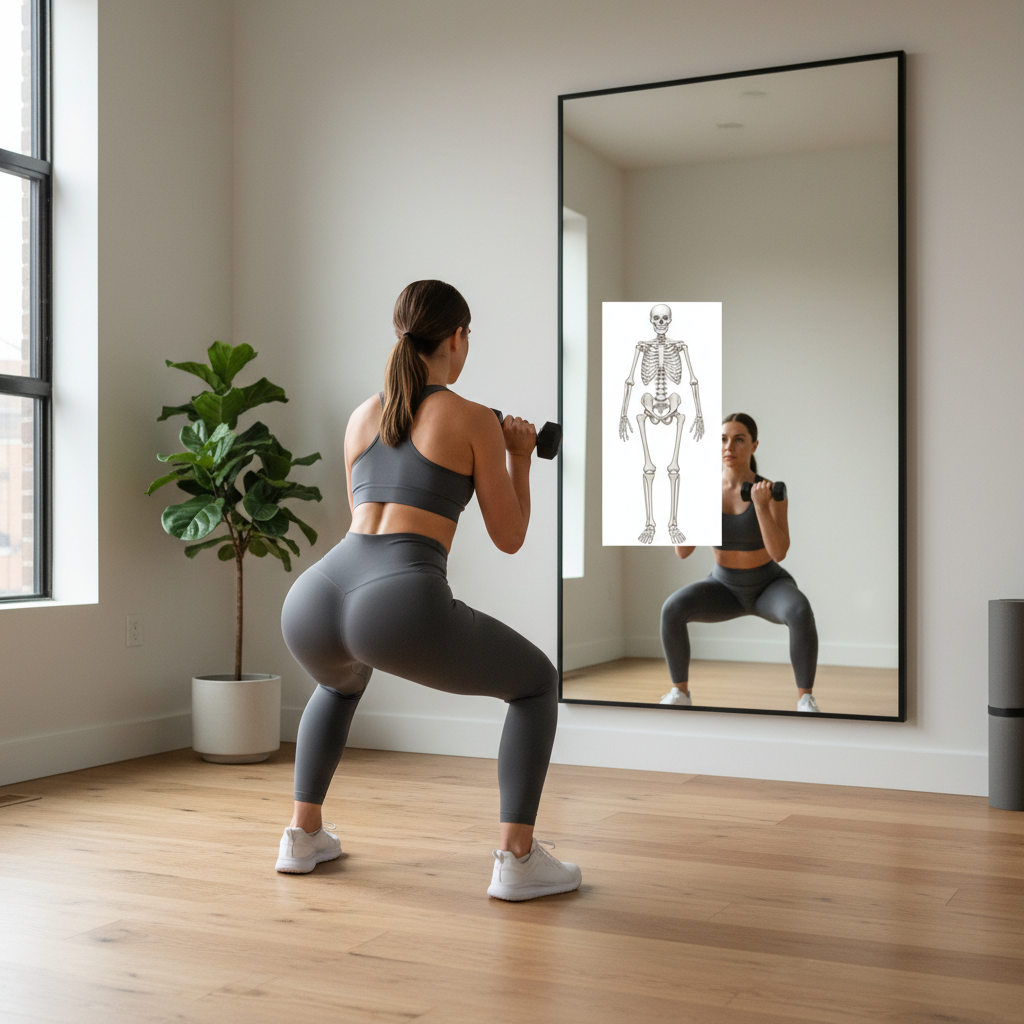
If your dumbbells cap out too light, you still have options: single-leg work, pauses, slower lowering, and shorter rest can keep women strength training challenging without needing a full rack of weights.
Safety cues, common mistakes, and when to get help
Good form is not about looking perfect, it is about staying in positions your joints tolerate while the target muscles do the work.
Quick form cues that usually help
- Squats: feet feel “tripod” on floor, ribs stacked over hips, depth only as far as you can control.
- Hinges: hips move back, shins mostly vertical, spine stays long, you should feel hamstrings load.
- Pressing: wrists neutral, shoulder blades stable, avoid shrugging toward ears.
- Rows: pull elbow toward hip, keep neck relaxed, avoid twisting for extra range.
Mistakes that waste time
- Changing the routine every week, then wondering why nothing sticks
- Training to exhaustion every session, then skipping the next one
- Ignoring pain signals and “pushing through” sharp or escalating pain
- Doing only lower body because it “burns more,” then dealing with shoulder posture and back fatigue later
When professional input is worth it
If you have persistent joint pain, numbness, dizziness, pelvic floor symptoms, or you are postpartum and unsure how to return to loading, it is reasonable to consult a physical therapist, a certified trainer with experience in your situation, or your healthcare clinician. Advice on the internet cannot see your movement or medical history, and some cases need individualized progression.
Key takeaways and next steps
Home strength work does not need fancy programming, it needs repeatable basics, steady progression, and enough recovery to show up again. Pick two full-body workouts, run them for 6–8 weeks, and track either reps or load so you can see momentum.
If you want a simple next step, choose your Workout A and B today, schedule three sessions on your calendar, and write down the first weights or reps you will use. That tiny act makes women strength training feel real instead of optional.
FAQ
How many days a week should women strength train at home?
Many people do well with 2–3 days per week. Two days can maintain and build steadily, three days often feels faster, assuming sleep and food support recovery.
Can I build muscle with just bodyweight exercises?
Often yes, especially early on, but you may hit a ceiling for lower body and pulling work. Progress tends to last longer with at least bands or adjustable dumbbells.
What if I only have one set of dumbbells?
Use unilateral moves like split squats and one-arm rows, slow down the lowering phase, and add pauses. Those tactics increase difficulty without more equipment.
Is “toning” different from strength training?
“Toning” usually means building a bit of muscle and reducing some body fat so definition shows. The training side still looks like strength work with progressive overload, just with realistic expectations and consistency.
How do I know if I am lifting heavy enough?
A practical check: at the end of a set, you should feel like you could do about 1–3 more clean reps. If you could do 10 more, it is probably too light for strength progress.
Should I do cardio on the same day as lifting?
You can, especially if it is light walking or an easy bike ride. If intense cardio makes your lifting worse or recovery harder, separate them by several hours or use different days.
What should I eat for strength training results?
Protein and overall calories matter, but exact targets vary by body size and goals. If you feel stuck, a registered dietitian can help tailor intake without extreme rules.
Is strength training safe during pregnancy or postpartum?
Many women continue training with modifications, but it depends on symptoms and medical guidance. Check with your OB-GYN or a pelvic health specialist for individualized guardrails.
If you are trying to make home workouts stick, a little structure goes a long way, especially when your schedule changes week to week. If you want, share what equipment you have and how many days you can realistically train, and I can help map the plan to your situation without making it complicated.