
Yoga for back pain can be a practical way to calm tight muscles, improve hip and spine mobility, and rebuild confidence in movement, but it works best when you match poses to the kind of discomfort you have.
If you have occasional stiffness after sitting, a cranky low back after workouts, or that “I feel fine until I bend” sensation, a few targeted yoga positions often help more than random stretching, mainly because they combine breathing, gentle strength, and control.
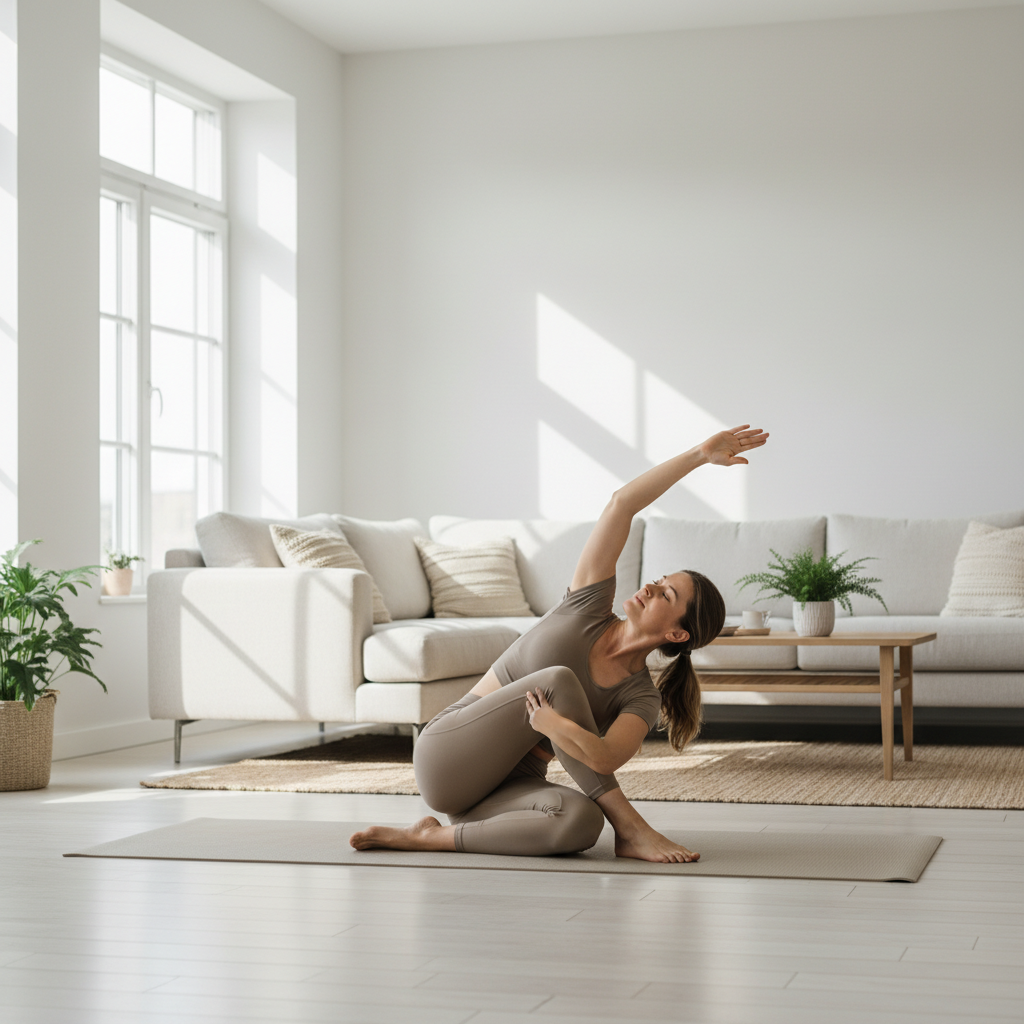
One quick misconception: more intensity is not always more relief. For many people, back pain responds better to small ranges done consistently than deep end-range stretches that irritate tissues.
Also, back pain is a big bucket. What feels “tight” could be protective guarding, joint sensitivity, nerve irritation, or simply poor load tolerance, so you’ll see options below and a simple way to self-sort before you try a routine.
Before you start: safety cues and who should be cautious
Yoga is generally considered a low-risk activity for many people, but back symptoms can change quickly, especially if nerves are involved. According to CDC guidance on physical activity, starting with safe, gradual movement and adjusting to your body’s response is usually recommended, and that mindset applies here too.
- Stop and seek medical advice if pain is severe, getting worse fast, follows a fall or injury, or comes with fever, unexplained weight loss, or bowel/bladder changes.
- If you have leg numbness, tingling, or shooting pain, you might still do yoga for back pain, but you’ll want to avoid aggressive forward folds and ask a clinician or physical therapist for tailored guidance.
- Pregnancy, osteoporosis, recent surgery, or known spinal conditions often require pose modifications, so checking with a professional is a safer move.
Two practical rules that keep most people out of trouble: keep discomfort at a “mild-to-moderate” level, and aim for symptoms that feel better or unchanged within 24 hours.
What yoga can (and can’t) do for back pain
For many common, non-specific back pain patterns, yoga helps by pairing mobility with stability, your hips and ribcage start doing their share again, and your lower back stops overworking. This can reduce morning stiffness and make daily activities feel less risky.
What yoga usually cannot do: “fix” a specific diagnosis overnight, or replace evaluation when symptoms point to nerve compression or systemic illness. According to NCCIH (National Center for Complementary and Integrative Health), yoga may help for low-back pain in many cases, but results vary and it’s most useful as part of a broader plan.
Think of yoga as a skill practice, not a one-time stretch session. You’re teaching your body new movement options.
Quick self-check: which back-pain pattern sounds like you?
You don’t need a perfect label, just a reasonable guess so you pick the right intensity and direction of movement. Read the options and choose the closest match.
- Sitting-stiff pattern: pain eases after walking, hips feel tight, back feels “compressed.” Often responds well to hip openers and gentle backbends.
- Bending-sensitive pattern: forward folds feel sharp or risky, mornings are worse. Often responds better to neutral-spine work and gentle extension rather than deep flexion.
- Overarched pattern: standing long periods bothers you, you feel it in the low back more than the glutes. Often improves with core endurance and hip-flexor length.
- Twist/rotation sensitive: turning in bed or twisting to grab something triggers pain. Often does better with stable, symmetrical poses at first.
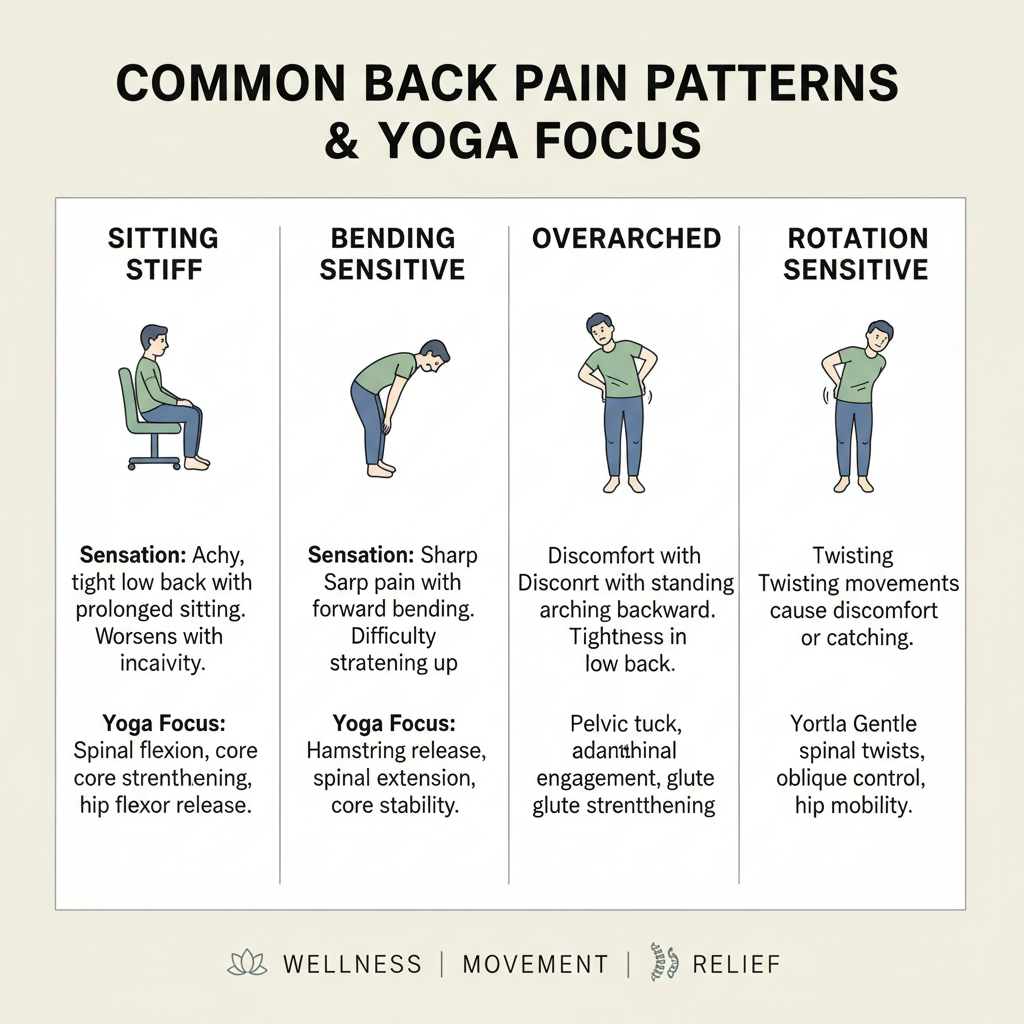
If your symptoms don’t fit any category, that’s normal. Use the routine later as a test, your body’s response over the next day tells you more than guessing does.
Yoga poses to relieve back pain (with simple cues)
These are common, generally well-tolerated options. Do them slowly, breathe normally, and use props. A folded blanket, a pillow, and a yoga block can make yoga for back pain feel dramatically more doable.
1) Child’s Pose (Balasana), with support
Good for: general tightness, stress-related guarding, gentle decompression.
- Knees wider, big toes touch, hips back toward heels.
- Place a pillow under your chest if your low back feels tugged.
- Stay 5–8 breaths, keep it easy.
2) Cat-Cow (Marjaryasana–Bitilasana), small range
Good for: stiffness, warming up without forcing a stretch.
- Hands under shoulders, knees under hips.
- Move slowly, keep the range small if bending-sensitive.
- Try 6–10 gentle cycles.
3) Supine Pelvic Tilts
Good for: learning neutral spine, calming an overarched low back.
- Lie on your back, knees bent, feet on floor.
- Exhale, lightly tip pelvis to flatten low back toward the mat, inhale to return.
- 8–12 reps, no pushing through pain.
4) Knees-to-Chest (Apanasana), one leg at a time
Good for: easing tightness without yanking on the spine.
- Bring one knee in, keep the other foot grounded.
- Hold behind the thigh if the knee is sensitive.
- 20–40 seconds each side.
5) Sphinx Pose (Salamba Bhujangasana)
Good for: bending-sensitive backs that often feel better with gentle extension.
- Lie prone, elbows under shoulders, forearms on mat.
- Lift chest softly, keep glutes relaxed, breathe.
- Hold 20–60 seconds, stop if leg symptoms increase.
6) Bridge Pose (Setu Bandhasana), low and steady
Good for: glute strength, hip extension, improving load tolerance.
- Feet hip-width, press through heels, lift hips only as high as comfortable.
- Think “ribs down,” avoid flaring.
- 6–10 reps, 2–3 breaths each, or hold 15–25 seconds.
7) Supported Reclined Twist (Supta Matsyendrasana), gentle
Good for: mild tension, but skip it if twisting triggers symptoms.
- Hug knees, drop them to one side onto a pillow.
- Keep shoulders heavy, breathe into ribs.
- 20–40 seconds, very light.
A simple 10–15 minute routine (pick one of two tracks)
If you’re not sure where to start, use one of these short sequences 3–5 days a week for two weeks. That frequency tends to matter more than doing a long class once.
| Track | Best for | Sequence (10–15 minutes) | What to avoid |
|---|---|---|---|
| Track A: Flexion-tolerant | Sitting-stiff, feels better after stretching | Child’s Pose 6–8 breaths → Cat-Cow 8 cycles → One-leg Knees-to-Chest 30s/side → Bridge 8 reps → Supported Twist 30s/side | Deep forward folds that pull hard on hamstrings |
| Track B: Flexion-sensitive | Bending feels risky, mornings worse | Pelvic Tilts 10 reps → Cat-Cow small range 6 cycles → Sphinx 30–45s → Bridge 6–8 reps → Child’s Pose with pillow 5 breaths (only if comfortable) | Long holds in rounding, aggressive hamstring stretching |
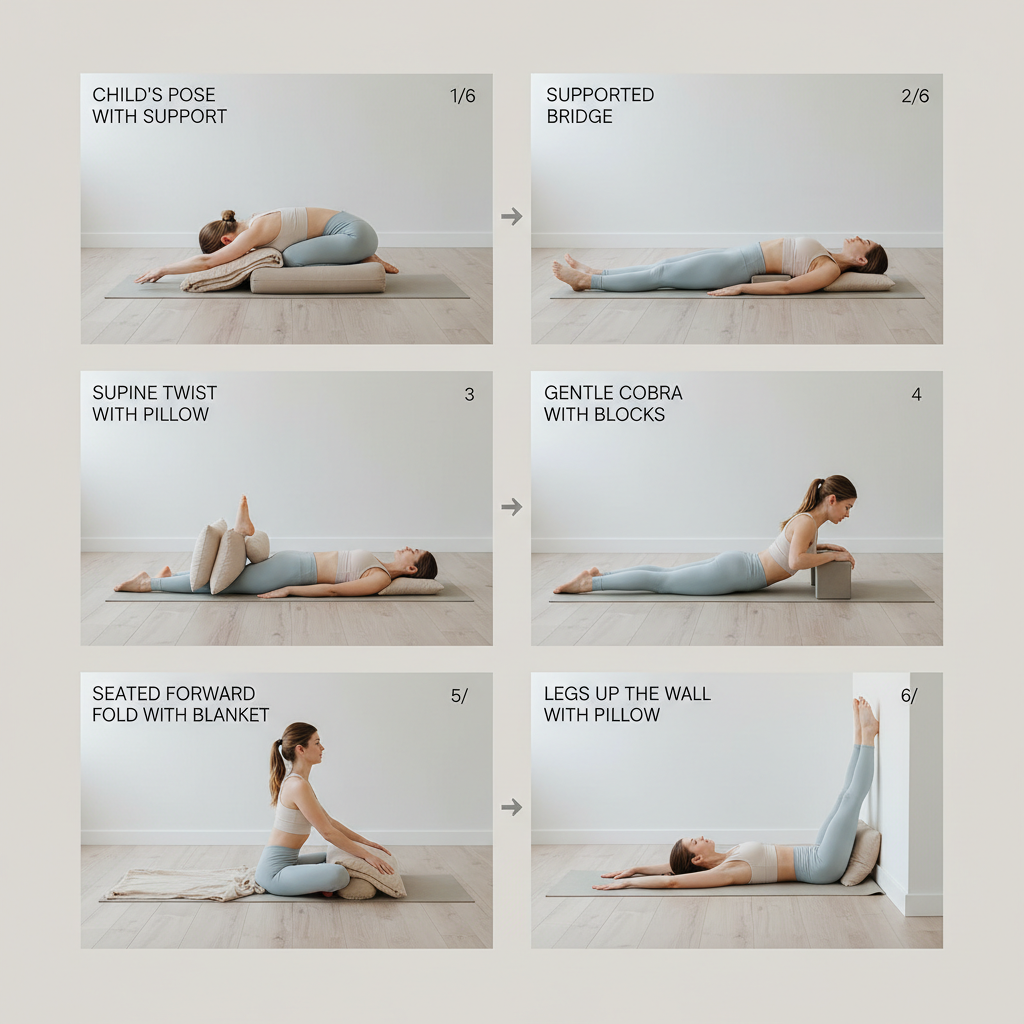
During the routine, you’re looking for a particular feeling: workable sensation without bracing. If you notice you’re holding your breath or clenching your jaw, back off a notch.
Make it stick: practical tips that matter more than “perfect form”
- Use props early. Most people wait too long, then blame yoga when it feels tight or awkward.
- Short daily practice beats occasional long sessions. For back comfort, consistency often wins.
- Add a tiny strength dose. Bridge holds, side planks on knees, or bird-dog variations can support long-term change, even if your goal is “less tight.”
- Walk after yoga. A 5–10 minute walk helps your nervous system “accept” the new range and can reduce rebound stiffness.
If you work at a desk, the hidden multiplier is usually your day-to-day movement. A few standing breaks often do more than hunting for one magical pose.
Common mistakes with yoga for back pain (and what to do instead)
- Chasing the deepest stretch: swap intensity for slower breathing and smaller range, especially early on.
- Forcing forward folds: hinge from hips with bent knees, or skip and build tolerance with bridges and gentle extension.
- Twisting hard “to crack it”: keep twists supported and mild, your back rarely needs more torque.
- Ignoring next-day feedback: your best guide is how you feel later, not how flexible you looked in the moment.
According to NIAMS (National Institute of Arthritis and Musculoskeletal and Skin Diseases), back pain is often managed with a mix of activity, posture habits, and appropriate exercise, which is a good reminder not to over-credit or over-blame any single session.
When to get professional help (and what to ask)
If you try a careful routine and pain keeps limiting basic tasks after 2–4 weeks, it’s reasonable to talk with a clinician or physical therapist. It’s not a failure, it’s just faster feedback.
- Ask if your symptoms suggest a nerve component and which movements to prioritize or avoid for now.
- Bring notes: what poses helped, what aggravated symptoms, and how you felt the next day.
- If you prefer yoga classes, look for an instructor comfortable with prop-based, therapeutic modifications, not only advanced flows.
Key takeaways
- Yoga for back pain works best when it’s targeted, not random stretching.
- Start with gentle, well-supported poses, then build a little strength.
- Use next-day symptoms as your scorecard, and scale up slowly.
- If red flags or nerve symptoms show up, get individualized guidance.
Conclusion: a calmer back usually comes from calmer choices
If your back pain feels stubborn, the answer is often less dramatic than people expect: pick a simple track, practice it consistently, and stop trying to “win” each stretch. Give it two weeks of steady effort, then adjust based on what your body reports the next day.
If you want an easy starting point, choose Track A or B above, put a reminder on your phone, and treat it like brushing your teeth, small, regular, and not up for negotiation.
FAQ
Which yoga pose is best for lower back pain?
It depends on what movements your back tolerates. Many people do well with Cat-Cow for gentle motion and Bridge for support, while bending-sensitive backs often prefer Sphinx over long forward folds.
How often should I do yoga for back pain?
For most people, 10–15 minutes 3–5 days per week is a realistic sweet spot. If you only practice once weekly, the benefits may feel inconsistent, especially for stiffness driven by lots of sitting.
Can yoga make back pain worse?
Yes, it can, usually when someone pushes into intense stretching, strong twists, or holds positions that increase symptoms. A safer approach is to keep discomfort mild and check how you feel later that day and the next morning.
Is it safe to do yoga if pain goes down my leg (sciatica-like symptoms)?
Sometimes, but this is a “go slower” situation. If leg symptoms increase with a pose, back off and consider professional guidance, because nerve irritation often responds better to specific direction-based movements than general stretching.
Should I stretch my hamstrings if my back hurts?
Maybe, but not automatically. Tight hamstrings can be part of the story, yet aggressive hamstring stretching can also pull on the pelvis and irritate a flexion-sensitive back, so start with bent-knee versions or focus on hip strength first.
What’s the difference between soreness and a warning sign?
Mild muscle soreness can feel achy and improves as you move. Warning signs tend to be sharp, progressively worse, or paired with numbness, tingling, or weakness, and they often linger or flare the next day.
Do I need a yoga class, or can I do this at home?
Home practice works well if you keep it simple and consistent. A class can help with accountability, but for back issues you’ll want an instructor who welcomes modifications and doesn’t pressure deep shapes.
If you’re trying to figure out which poses fit your symptoms, or you’d rather follow a routine without second-guessing form, consider working with a qualified yoga therapist or physical therapist for a session or two, it often saves time and reduces trial-and-error.