
Weight training at home can work surprisingly well, but most people get stuck on the same problem: they do random workouts, feel sore, and still don’t see steady strength gains.
The fix is not “more exercises”, it’s a routine you can repeat, track, and progress. Once you know what to do on Monday versus Thursday, and how to add challenge without wrecking your joints, results become much more predictable.
This guide gives you a practical home routine (with options for dumbbells, bands, or just bodyweight), a simple weekly schedule, and the rules that keep you progressing when motivation dips.
What “good” weight training at home actually looks like
A solid home program usually has three traits: you train the big movement patterns, you repeat them often enough to improve, and you add difficulty in small steps.
- Movement patterns: squat/lunge, hinge, push, pull, carry, and core stability.
- Repeatable schedule: 2–4 strength days per week, not seven days of chaos.
- Progressive overload: more reps, more load, slower tempo, harder variation, or shorter rest over time.
According to the American College of Sports Medicine (ACSM), Resistance Training is a core part of a balanced fitness plan, and progression matters for continued adaptation. You don’t need a gym to apply that principle, you just need a consistent way to make the work slightly harder.
Quick self-check: choose the right starting plan
Before you copy a routine from someone who trains five days a week, be honest about your current base. This avoids the classic boom-and-bust cycle.
- If you’re brand new or returning: 2–3 full-body sessions per week, focus on form and repeatability.
- If you can already do clean push-ups and controlled squats: 3 days per week, slightly more volume and a bit more intensity.
- If you have limited equipment: prioritize single-leg work, tempo (slow lowering), and higher reps.
- If joints get cranky: reduce range of motion, slow down, use supported variations, and consider asking a qualified trainer or clinician.
One more reality check: weight training at home feels “easy” early on because loads are lighter, but the limiting factor becomes creativity in progression. That’s why the next sections are specific about how to level up.
Equipment options (and what to buy first)
You can get strong with minimal gear. Still, a few items make home training more scalable and less annoying.
Best “first purchases” for most people
- Adjustable dumbbells or a couple pairs (light/medium).
- Long loop resistance bands for rows, pulldown-style work, and assistance.
- A sturdy chair or bench for split squats, presses, step-ups.
- Pull-up bar if your doorway and setup are safe and compatible.
No weights? Still workable
- Use tempo (3–5 seconds down), pauses, and one-leg variations.
- Use a backpack with books for loading, but keep it stable and avoid awkward shifting.
- Prioritize safe pulling options (bands under the feet, towel rows around a sturdy post).

The home weight training routine (3 days/week, full-body)
This plan is built around repeatable basics. Each day has a squat/lunge, hinge, push, pull, plus core or carry. You can run it for 6–8 weeks before making bigger changes.
How hard should it feel? Aim for about 1–3 reps in reserve on most sets, meaning you could do a couple more reps with good form if you had to. If you’re unsure, err slightly easier for the first two weeks.
Workout A
- Goblet squat (dumbbell or backpack): 3 sets x 8–12 reps
- One-arm dumbbell row (or band row): 3 x 8–12 each side
- Push-up (incline if needed): 3 x 6–12
- Romanian deadlift (dumbbells): 3 x 8–12
- Front plank: 3 x 20–45 seconds
Workout B
- Split squat (rear foot on floor or elevated): 3 x 8–12 each side
- Overhead press (dumbbells or band): 3 x 6–10
- Band pulldown (anchored) or assisted pull-up: 3 x 6–12
- Hip hinge option: hip thrust or glute bridge: 3 x 10–15
- Dead bug: 3 x 6–10 each side
Workout C
- Step-up (chair/bench) or squat variation: 3 x 8–12 each side
- Floor press (dumbbells) or push-up variation: 3 x 8–12
- Chest-supported row (incline bench) or band row: 3 x 10–15
- Single-leg RDL (light dumbbells): 3 x 8–12 each side
- Suitcase carry (one heavy dumbbell): 4 x 20–40 steps
Weekly schedule idea: Mon A, Wed B, Fri C. If your week gets messy, do A and B, then pick up with C next time. Consistency beats perfection in weight training at home.
Progression rules: how to get stronger without overthinking
People don’t stall because they “need new exercises”, they stall because they never increase the challenge in a measurable way.
Use this simple progression ladder
- Add reps until you hit the top of the rep range for all sets.
- Add a little load (the smallest jump you have) and drop reps back to the low end.
- Slow the lowering to 3–4 seconds if you can’t add weight yet.
- Upgrade the variation (incline push-up → floor push-up → feet-elevated).
- Shorten rest modestly, only if form stays clean.
A tiny tracking method that actually gets used
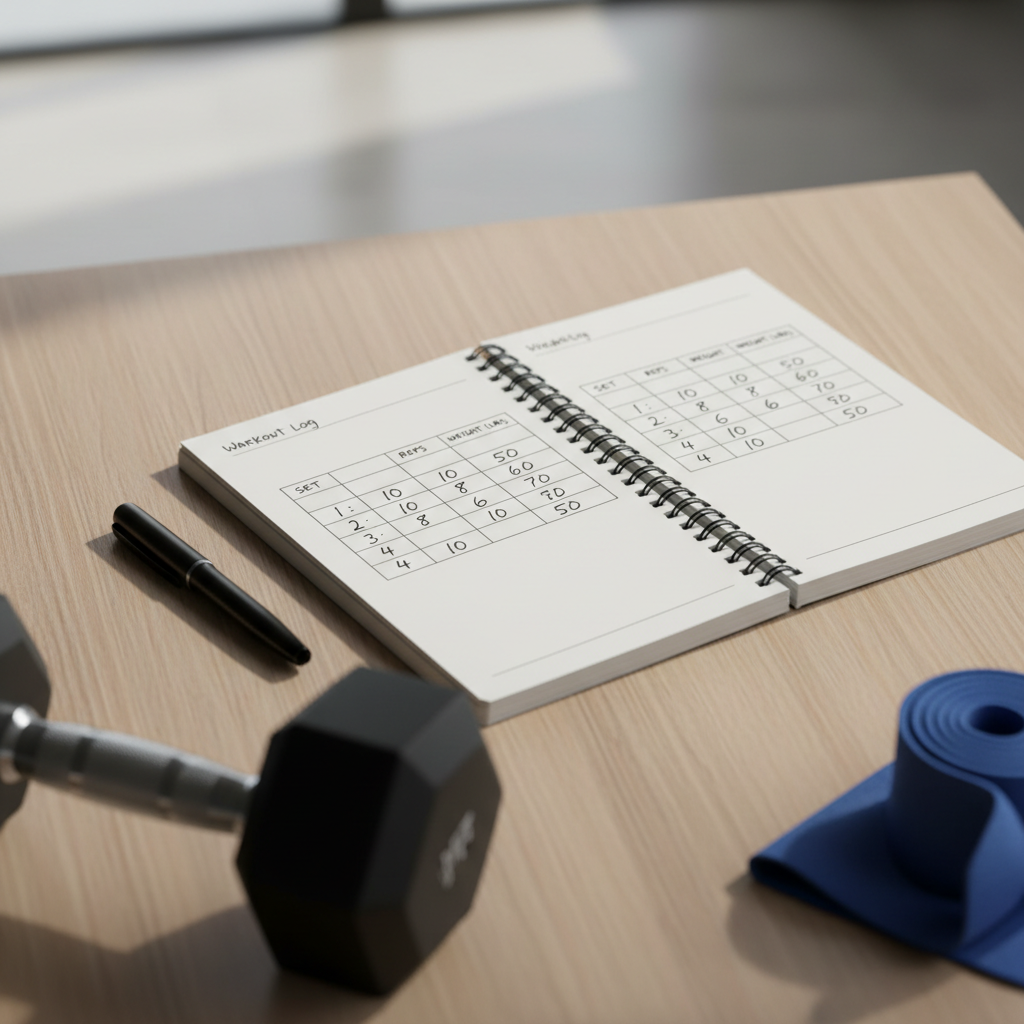
- Write down: exercise, load, reps, and a quick note like “felt easy” or “2 reps left.”
- Try to beat last week by one small thing, not everything at once.
Practical session structure (warm-up, rest times, and form cues)
Keep the session boring in a good way. Same structure each time, fewer decisions, more follow-through.
Warm-up (5–8 minutes)
- 1–2 minutes easy movement (marching, step-ups, brisk walk around the house)
- 2–3 mobility drills that match the day (hip hinge patterning, shoulder circles)
- 1 lighter “ramp-up” set for your first two exercises
Rest times that fit most home routines
- Main lifts (squat/hinge/push/pull): 60–120 seconds
- Accessories/core: 30–75 seconds
Form cues that prevent most mistakes
- Brace: exhale slightly, tighten midsection like someone might poke your ribs.
- Control the lowering: if reps bounce, load often too heavy for now.
- Joint comfort matters: sharp pain is a stop signal, not a grit test.
According to the Centers for Disease Control and Prevention (CDC), strength training is part of general health guidance for adults. That doesn’t mean every movement fits every body, so adjust range of motion and variations when needed.
At-a-glance routine table (save this)
If you want something you can screenshot, this is the plan in one view.
| Day | Main focus | Exercises | Sets x reps |
|---|---|---|---|
| A | Squat + pull | Goblet squat, 1-arm row, push-up, RDL, plank | 3 x 8–12 (plank 3 x 20–45s) |
| B | Lunge + press | Split squat, overhead press, pulldown/pull-up, hip thrust, dead bug | 3 x 6–12 (dead bug 3 x 6–10/side) |
| C | Single-leg + carry | Step-up, floor press, row, single-leg RDL, suitcase carry | 3 x 8–15 (carry 4 x 20–40 steps) |
Common mistakes (and the quick fixes)
- Doing only “mirror muscles” (push-ups and curls): add rows, hinges, and carries so shoulders and back keep up.
- Going to failure every set: save true all-out sets for occasional tests, not daily training.
- Skipping pulling work because it’s inconvenient: bands, a table row, or a door-anchor setup usually solves this.
- Changing the plan weekly: give the routine time, most progress looks boring on paper.
- Ignoring recovery: sleep, protein, and stress load can make or break weight training at home.
When to scale back or get professional help
If you feel mild muscle soreness, that’s common. If you notice sharp pain, numbness, dizziness, or symptoms that worsen session to session, it’s smarter to pause and consider talking with a qualified healthcare professional or certified trainer who can evaluate your situation.
Also consider help if you have a history of major joint injury, recent surgery, uncontrolled blood pressure, or you’re pregnant and unsure how to modify. In many cases you can still train, but the safest version is often individualized.
Key takeaways you can use this week
- Pick a 3-day full-body routine and run it for 6–8 weeks before swapping exercises.
- Progress one variable at a time, usually reps first, then load or tempo.
- Cover push, pull, squat/lunge, hinge every week, your body tends to feel better long-term.
- Track something small, even a notes app log is enough.
If you want a clean starting point, choose your equipment level, schedule three sessions, and complete just the first two weeks with good form. Once you do that, you’re no longer “trying” weight training at home, you’re practicing it.
FAQ
How long should a home strength workout take?
For most beginners, 35–55 minutes works well, including warm-up. If you only have 25 minutes, keep the same exercises and do fewer sets, consistency beats a perfect duration.
Can I build muscle with weight training at home using light dumbbells?
Often yes, especially if you use higher reps, slower lowering, pauses, and single-leg variations. The main limit is eventually you may outgrow the load, then you’ll need heavier weights or tougher progressions.
What if I don’t have a pull-up bar?
Bands can cover a lot: band rows, band pulldowns with a safe anchor, and even face pulls. The goal is balanced shoulder work, not a specific piece of equipment.
Should I do cardio on the same days?
Many people can, but keep it moderate at first. If strength numbers stall or legs feel constantly heavy, separate hard cardio and lower-body lifting by a day when possible.
How do I know if I’m lifting “heavy enough” at home?
If you finish sets with 5–8 reps left every time, it’s probably too easy to drive progress. Aim to finish most working sets feeling like you had 1–3 good reps left, while keeping form steady.
Is soreness a sign the workout worked?
Not reliably. Soreness can happen when you change exercises or increase volume, but progress is better judged by reps, load, control, and how you recover week to week.
Do I need supplements for results?
No. Many people do fine focusing on protein intake, total calories that match their goal, and sleep. If you consider supplements, it may help to ask a healthcare professional, especially if you take medications.
If you’re trying to make weight training at home feel less scattered, a pre-built plan with clear progress targets can save time and decision fatigue, especially when your schedule changes week to week.